
Home | Lineage and Birth | The early years. | Conrad the Mountee. | 23rd of August 1914 | Captivity Espionage and Escapes | Augustabad | Barry Bingham VC | Conrad meets M | Conrad Assistant Military Atache. | The Last Tigerhunt. | The Archaeology of the Reich | From Intrigue and artifice to Art. | The names Ffrench, Conrad Ffrench. | Ian Fleming | The Black Ore of Death | An Evil Medium | Off the Chessboard. | Arbutus Point. | Conrad retires to the field | The Art of Conrad O'Brien-Ffrench | The Quotient of Conjecture. | News and Gossip | Bookshop & Bibliography | Mailbag | Related Links | Contact Me

Conrad Faulk O'Brien-ffrench. Artist and Spy.

The Last Tigerhunt.

The swansong of the British Raj.

image_00061.jpg

image_00253.jpg

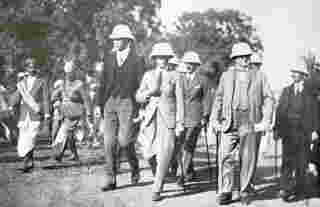
Edward VIII on an indian Walkabout
Reproduced with kind permission of John Ffrench

With rumor of drastic cuts in the air and having seen his friend Lord Acton's diplomatic career end so abruptly the previous year Conrad applied for leave. He arrived back in London in the summer of 1921. His role as Military Attaché over.  Conrad was an established mover in the highest circles. He had the reputation of being a man to be relied upon for his good sense and discretion.  So soon after his return he was chosen to be an aide-de-camp for one of the Indian Governors during what was to be the final Royal Tiger hunt during the winter of 1921-22.  This was the swan song of the British Raj. Gandhi, Nehru and the Indian National Congress Party were gaining power. All too soon the party would come to an end. But while Conrad was there during the Princes visit the Party was in full swing. It was Conrad’s responsibility as ADC to see it stayed that way. It was a difficult tour as the Indian Congress and Gandhi were staging demonstrations of Passive resistance wherever the Prince went. More than once they were dispersed with the utmost brutality by the local British forces. It was an uncomfortable tour. Conrad the ADC was just the man to keep a knowing eye on things while the party went on.

 He recalls early one morning after yet another grand party, finding caviar sandwiches and a champagne bottle on his desk, literally the breakfast of King’s.  The Prince had risen early and was out knocking a polo ball about with Fruity Metcalf, the Prince's friend personal aide-de-camp. Conrad fulfilled his duties with aplomb and became a trusted part of the future Kings retinue. He tells how at dinner he occupied the humble end of the lengthy table and was seated next to Lord Louis Mountbatten another chance meeting of a major player in the drama to come. The exalted end was occupied by The Prince with the Governor Sir Harcourt Butler, Lord Cromer, Sir Lionel Halsey, Godfrey Thomas, Piers Leigh,  and guests with a smattering of Indian Princes. He complains that his duties often took him away from such parties early to greet arriving guests. Conrad describes the ADC as  “a fool, a footman and everybody’s friend!“ The duties of the aide-de-camp are defined in the Oxford dictionary as “An officer who assists a General in the field, by conveying his orders, procuring him intelligence, etc.”  Conrad the spy was in his element. As M’s man he was ideally placed. Though little is said in his book about this aspect of his remit Conrad was busy fulfilling his duties in both respects. He recalls how in February 1922 while shooting big game with the Governor in Terhai, Lord Reading the Viceroy had interrupted their sport to discuss the possible arrest of Gandhi with the Governor. An action Conrad had deplored at the time as they were having such good sport. On March 10th Gandhi was arrested and sentenced to six years imprisonment for sedition. Conrad was in the centre of things and an intimate of the main characters of the unfolding events which were to be the last days of the British Raj.

His time in India also introduced him to what was to be an abiding interest in his life, Mountaineering. He felt a kindred spirit with the Sherpa inhabitants of the high mountains. He shared their common love of a “something beyond”. He goes on to tell how he enjoyed the friendship of other mountain lovers too including Sir Francis Younghusband, Frank Smythe and later Sir John Hunt and Sir Edmund Hillary. Conrad became a lifelong member of the Alpine Club. His mountaineering exploits earned him the nickname of Eagle in his Regiment. Once the Princes tour of India ended Conrad returned to his regiment, who were stationed in India. After the high life of the tour his duties as a cavalry officer during the beginning of the preparatory season were stressful. Staging extra drills for those who were in need, the bringing up of equipment and horses to full muster in readiness for the training season. Conrad found the arbitrary exactitude and precision of soldiering in the searing heat of an Indian summer made him ill. He applied for leave and was soon on route to Srinagar and the cool air of the mountains. Conrad spent his leave hunting Ibex and climbing in the mountains. Much recovered he returned to his regiment and was soon transferred back to London where he was demobilized and returned to civilian life.


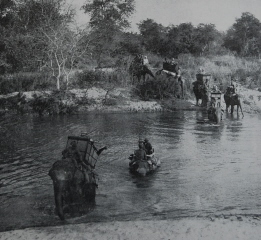
A Royal Tiger Hunt.
Reproduced with kind permission of John Ffrench

image_00208.jpg

Next Page

Enter supporting content here

Supporting Reference
Wikipedia
Wikipedia

© Copyright. Paul Atkinson 2007. 00brien.com