It was in
June 1935 when Conrad went to Riks gränsen in Lapland to find good skiing, and to be
near Maud in Stockholm whose time was near. His hotel
overlooked the railway lines. He noticed more and more trains laden with iron
ore were passing by. On an impulse, he pocketed his passport and hopped on one
of the passing trains. The journey took him along the Norwegian coast to the
seaport of Narvik. There he found the ore being loaded onto German and Dutch
ships. He sought out a Dutch sailor and enquired where the ore was going. The
sailor disclosed that it was destined for the Rhineland, either for the Krupps munitions
factory or to steelworks in the Saarland. He asked how long this had been
going on. Not very long, he was told, only since Hitler had started to rearm.
This was news indeed! Conrad headed for Stockholm and searched out the Consul
General. They had no idea of the flow of iron ore to Germany. Conrad wired Menzies with the
news. Menzies telephoned him with warm congratulations and requested he return
to London without delay. As Maud was so close to her time, it
was agreed he should come at his earliest convenience after the birth. While he
waited, Conrad bought an English sports car and toured round the mines,
checking how many were exporting ore to Germany. Most were, and he gathered
information of the quantities being shipped to corroborate his initial report.
On the 9 July, Christina was born. Having ensured that she and her mother were
in good health, he booked passage to England. Conrad met Menzies and provided
him with all the information he had compiled. In 1940, and as a direct result
of his intelligence, his friend, Peter Fleming, would find himself involved in
the Narvik
affair, culminating in a short-lived occupation of the port.
Conrad
enjoyed a brief break in Ireland with Rozzie at Monivea. Since
Kathleen’s departure, things had not gone well. All monies from Kathleen had
stopped and the house was in disrepair. He sent a letter to Kathleen in Harbin offering
to take things in hand
and restore the estate for her. He shared this action with Rozzie – a bad move;
she treated him with suspicion thereafter. He had always secretly held aspirations
to have Monivea, but this letter destroyed any hopes he had entertained in that
respect. He returned to London and had a meeting with Menzies in
White’s gentleman’s club. He expected to be returning directly to Austria, but
SM had different ideas.
Conrad was bound for Harbin using a visit to Kathleen as cover. She had settled there amid a community of Russians who for
one reason or another had made it their home after the Revolution, they were known as the Harbin Russians. Peter Fleming was an expert on Indo-China
and undoubtedly played a part in the arrangements. When all was arranged,
Conrad returned to Kitzbühel, packed his bags and headed for Berlin and the Manchuria Express.
After a long and largely uneventful journey across Russia and Siberia, Conrad arrived at his
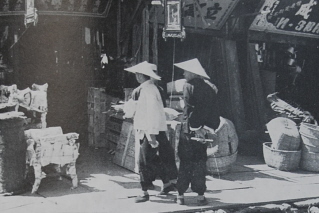
destination. Harbin
was of ill repute – an “evil city”. It
had over 200,000 Orientals and 65,000 Europeans living under a tyrannical
Japanese rule. It had been little more than a village until the Russians had
built a massive bridge over the Sungari river a few years earlier. Since
then, it had mushroomed into a crowded and squalid city. Esconced in the Hotel
Modern, Conrad contacted the British representative to acquaint himself of the
local conditions and areas of interest. They took a launch up the river. It was
the only place they could be certain of not being overheard; Harbin was crawling with spies and
informers working for the Japanese and other powers. One could only venture six
miles upstream as any further would have taken them into bandit country. He
recalls seeing a Japanese officer beheading some malefactor as they passed,
then just letting his body fall into the river. This was a barbaric place –
Conrad was left in no doubt of that on his first day.
When they
returned, Conrad made his way to Kathleen’s residence at 16 Bolshoi Prospect.
It was a large villa which she shared with her companion, a Princess Uhtomski,
and a largely unseen Russian orthodox Abbess. It was Conrad’s luck that,
despite her relative poverty, Kathleen still entertained regularly and it seems
her villa had become a focal point of political discussion, if not intrigue, in
Harbin. Her supper parties were often attended by the British,
French and Italian Consuls. Another visitor was a Latvian man who became a
valuable contact and provided Conrad with much information. He introduced him
to ‘Ivan’, a Russian working for the Japanese at their military headquarters.
Ivan provided him with maps and documents and gave him the exact details and
disposition of Japanese troops in Manchukuo. This was a scoop beyond his
hopes, and Conrad was soon making plans for his return. He had, however, failed
to get Kathleen to discuss Monivea, and reluctantly accepted that his hopes of
tenure were unlikely to be realised.
Conrad
also tells of a Japanese plot against Western morals in Harbin. They provided cheap heroin to the
city’s many Russian addicts. At night, the hotel porter would use his pass key
and let once prosperous Russian girls, now reduced to earning their living
through prostitution, into the rooms of single men. Conrad awoke one night to
the sound of a key in the door and shouted out “Go to the devil!” to the unseen
female intruder. She replied in perfect English “That’s just what I thought I
was doing.” Before she left, he had gained much knowledge of this plot. It was
time for him to leave.
When
Conrad went to see Kathleen for the last time, she gave him a set of golden
Russian enamelled spoons as a parting gift. Conrad would never see her again;
she would end her days in Harbin, despite harbouring hopes to
return to Monivea to die. He was making ready to leave for the station the
following morning when the Latvian came to him. They went for a drink of
coffee. Ivan, he learned, had been arrested for espionage. “I looked at my
informer blankly and took another lump of sugar in my coffee. ‘This coffee is
awfully bitter,’ I remarked. ‘Perhaps the Russian coffee is bitter too, and the
German coffee as well,’ said the Latvian significantly. ‘Yes,’ I sighed. ‘Café
au lait is best.’” (DM p. 144)
This
guarded and inscrutable conversation in a public place was the closing remark
of another successful mission for Conrad.
On the
train he met a young Russian girl, Irene, who was going to England to her father’s family. She spoke
almost no English and had too much luggage. Conrad realised that it would
attract the attention of Dimitri, the OGPU (Soviet Secret Police) informer on
the train. She had intended to pass on a mink coat and other articles to an
aunt in Moscow, but on their arrival no aunt was
to be seen. There were two Chinese trunks to be explained, and Irene was on the
point of being arrested by the Soviets when Conrad intervened. He emphatically
explained that, despite the tickets, the trunks were bound for Berlin and that her mother had given him
express instructions to ensure they got there. He demanded them re-stamped
immediately and put back on the train. Luckily, Dimitri was from Moscow and keen to be on his way home, so
he gave no argument. The trunks were reloaded on the train and their journey
continued. But Conrad had been noticed by the new guard. That night, he came to
Conrad’s compartment and woke him by flashing a torch in his face, asking a
question as he awoke. Conrad answered in Russian inadvertently. “So you do
speak Russian,” said the guard. Conrad was watched closely for the remainder of
the journey, until at the Polish border they left the Russian train behind and
enjoyed the comfort of the Polish restaurant car.
*From the article “The James Bond of West Vancouver” by Walter Stuart